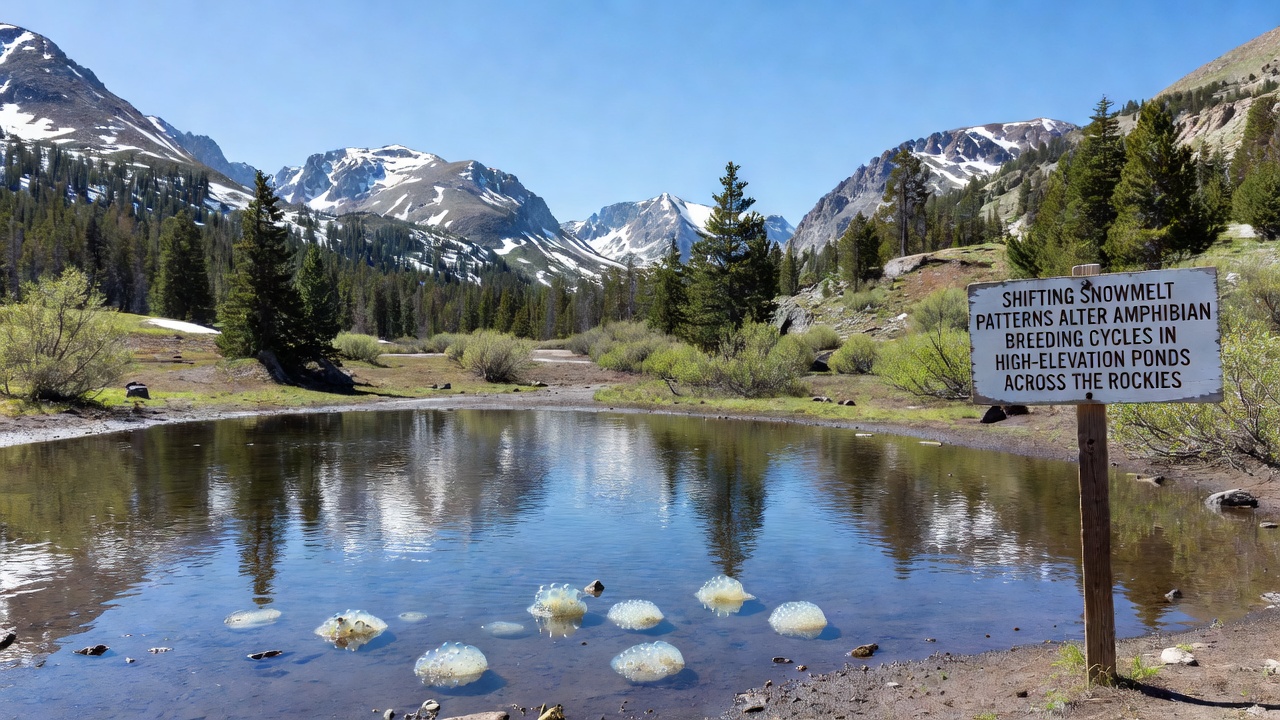
Amir Simon · 26 October 2026
Shifting Snowmelt Patterns Alter Amphibian Breeding Cycles in High-Elevation Ponds Across the Rockies
Researchers tracking high-elevation ecosystems have documented how earlier snowmelt across the Rocky Mountains is reshaping the timing of amphibian reproduction in isolated ponds, and this shift brings measurable changes to breeding success for species like the boreal toad and wood frog. Data collected from monitoring stations in Colorado, Montana, and Alberta show that snowpack now melts an average of 10 to 20 days sooner than it did four decades ago, which compresses the window when ponds hold sufficient water for egg development and larval growth.
Observed Changes in Pond Hydrology
Long-term records from the USGS and Environment and Climate Change Canada reveal that peak snowmelt runoff now arrives earlier in spring while total water volume in many high-elevation basins has declined, and these trends leave shallow ponds drying faster under warmer summer temperatures. Amphibians that once deposited eggs in late May now encounter exposed mud or reduced water depths by mid-June, forcing larvae to complete metamorphosis in shorter periods or risk desiccation.
One study spanning three decades across 47 ponds in the central Rockies found that breeding calls and egg masses appeared 12 days earlier on average between 1995 and 2025, yet the date of pond drying advanced by 18 days over the same interval, and this mismatch leaves tadpoles stranded in shrinking pools. Observers note that ponds at elevations above 3,000 meters experience the most pronounced compression because they rely almost entirely on snowmelt rather than summer rainfall.
Species-Specific Responses
Boreal toads have adjusted their breeding onset in response to warmer spring air temperatures, yet their embryos remain sensitive to rapid temperature swings that follow early snow disappearance, and researchers recorded higher rates of developmental abnormalities in clutches laid before full ice-off. Wood frogs, by contrast, show greater flexibility in egg-laying timing but still face reduced food availability when aquatic insects emerge out of sync with tadpole hatching.
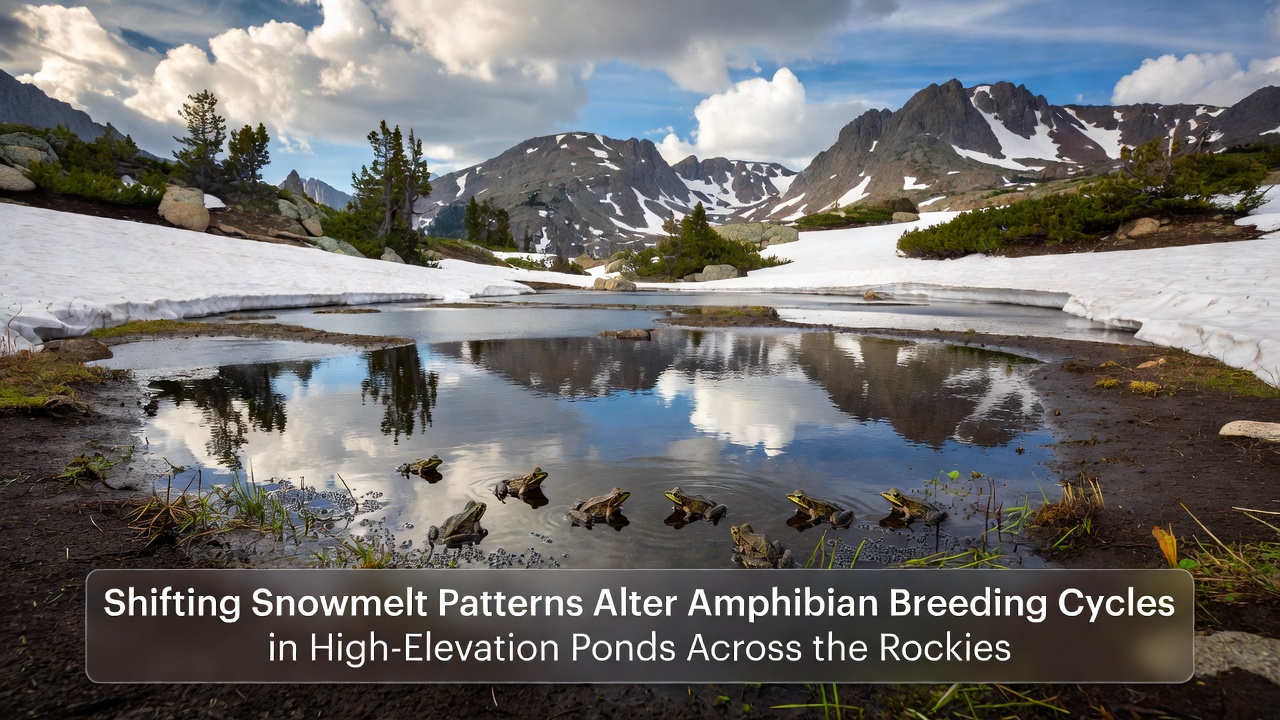
Field teams in the Absaroka-Beartooth Wilderness documented that chorus frog populations maintained stable breeding dates despite earlier melt because they select deeper ponds that retain water longer, and this habitat choice buffers some effects of shifting hydrology. Yet even these more resilient species experience increased predation pressure when larvae concentrate in the remaining water as ponds shrink. Data from acoustic surveys indicate that calling activity now peaks in a narrower window, reducing opportunities for females to select optimal mates under favorable conditions.
Broader Ecological Connections
Changes in amphibian phenology ripple through food webs because emerging insects and algae blooms also track snowmelt timing, and when tadpoles hatch after peak insect abundance they encounter lower prey densities that slow growth rates. A collaborative project between the University of Montana and Parks Canada tracked nutrient cycling in 22 ponds and found that earlier drying reduced the export of amphibian biomass to terrestrial ecosystems by roughly 25 percent compared with baseline years in the 1990s.
October 2026 monitoring reports from sites in Wyoming's Wind River Range showed that ponds refilled modestly from autumn rains yet remained shallower than historical norms, and biologists expect this carry-over effect to influence overwintering habitat availability for adult amphibians seeking refuge under ice. Continued tracking through the next several seasons will clarify whether these patterns represent temporary variability or a persistent directional shift driven by rising temperatures.
Monitoring and Adaptation Efforts
Wildlife agencies have expanded automated sensor networks to capture daily water temperature, depth, and conductivity at breeding sites, and these instruments transmit data that allow rapid assessment of pond persistence relative to predicted snowmelt dates. In several jurisdictions, managers now adjust grazing permits and recreational access to minimize additional disturbance around sensitive ponds during critical larval periods.
Restoration experiments that deepen pond basins or create adjacent ephemeral pools have shown mixed results, with some sites supporting higher metamorphosis rates while others experience increased colonization by non-native predators. Researchers continue to evaluate whether assisted migration of egg masses to later-drying ponds could offset some losses, though such interventions remain limited in scale and require careful genetic monitoring.
Conclusion
Shifting snowmelt regimes across the Rockies have compressed the hydroperiod of high-elevation ponds and altered the temporal alignment between amphibian breeding and resource availability, and long-term datasets confirm these changes affect multiple species in measurable ways. Ongoing sensor networks and coordinated field studies provide the evidence base needed to understand how these dynamics evolve, while management actions focus on protecting remaining habitat features that support successful reproduction under new seasonal patterns.